How to Prepare for a Remote Job Interview: Questions and Winning Answers (2027 Guide)
Getting the interview is half the battle. For remote roles, the interview itself is a different game from the office kind — you are on camera, your home is part of the first impression, and every answer is judged on whether you sound like someone who can thrive without a manager in the next room.
If you want to walk in (or log in) confident, start by mastering the remote job interview questions employers ask most often — and understanding what they are really listening for. This guide covers the full playbook: how to set up your room and tech, the questions you will almost certainly face with sample answers that actually work, the smart questions you should ask back, and what to do after the call ends. Whether this is your first interview ever or your first remote one, preparation is what turns nervous energy into an offer.
Why Remote Job Interviews Are Different
An office interview tests whether you can do the job. A remote interview tests that plus one more thing: whether you can do the job from your bedroom. Hiring managers know that a brilliant in-person worker can fail remotely if they cannot communicate in writing, manage their own hours, or stay focused without supervision. So alongside the usual questions, expect several designed to probe exactly that.
The format is different too. Most remote interviews happen on video — sometimes one call, sometimes three rounds with different team members. Occasionally you will get an async interview: written answers submitted through a form or recorded video answers you film on your own time. Each format rewards preparation in slightly different ways, but the core principle is the same: the interviewer cannot see your work ethic directly, so everything you show them has to demonstrate it.
Set Up Your Room and Tech the Day Before
Nothing sinks a remote interview faster than fumbling with technology while the interviewer waits. Do this setup at least a day ahead, not ten minutes before.
Your room: Pick a quiet spot with a plain, uncluttered background — a blank wall, a bookshelf, or a simple curtain. Face a window or put a lamp behind your camera so light falls on your face, not behind you (backlighting turns you into a silhouette). Close the door, silence notifications, and warn the household you will be unavailable.
Your tech: Test your camera, microphone, and internet speed. Join the meeting link five minutes early to confirm it works — some platforms need an app download you have not installed. Keep a phone hotspot ready as a backup in case the Wi-Fi drops. And close every unnecessary tab: screen-sharing your desktop with twenty open tabs is the remote equivalent of walking in with your shirt untucked.
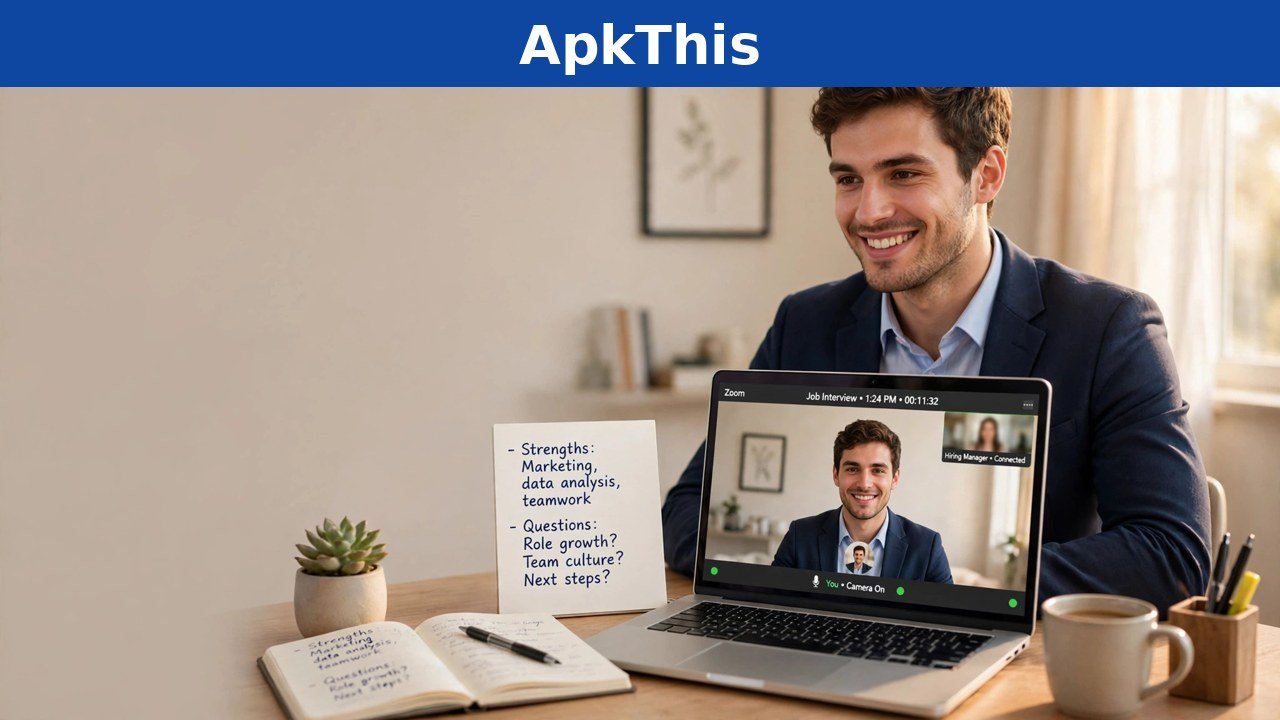
Your materials: Keep your CV open on the screen (our guide on how to write a CV that gets you hired helps if yours needs work), a glass of water nearby, a notebook with your prepared questions, and a pen. A notebook also gives you somewhere to write down the interviewer’s name and key points they mention — details you can reference in your thank-you note later.
Common Remote Job Interview Questions and How to Answer Them
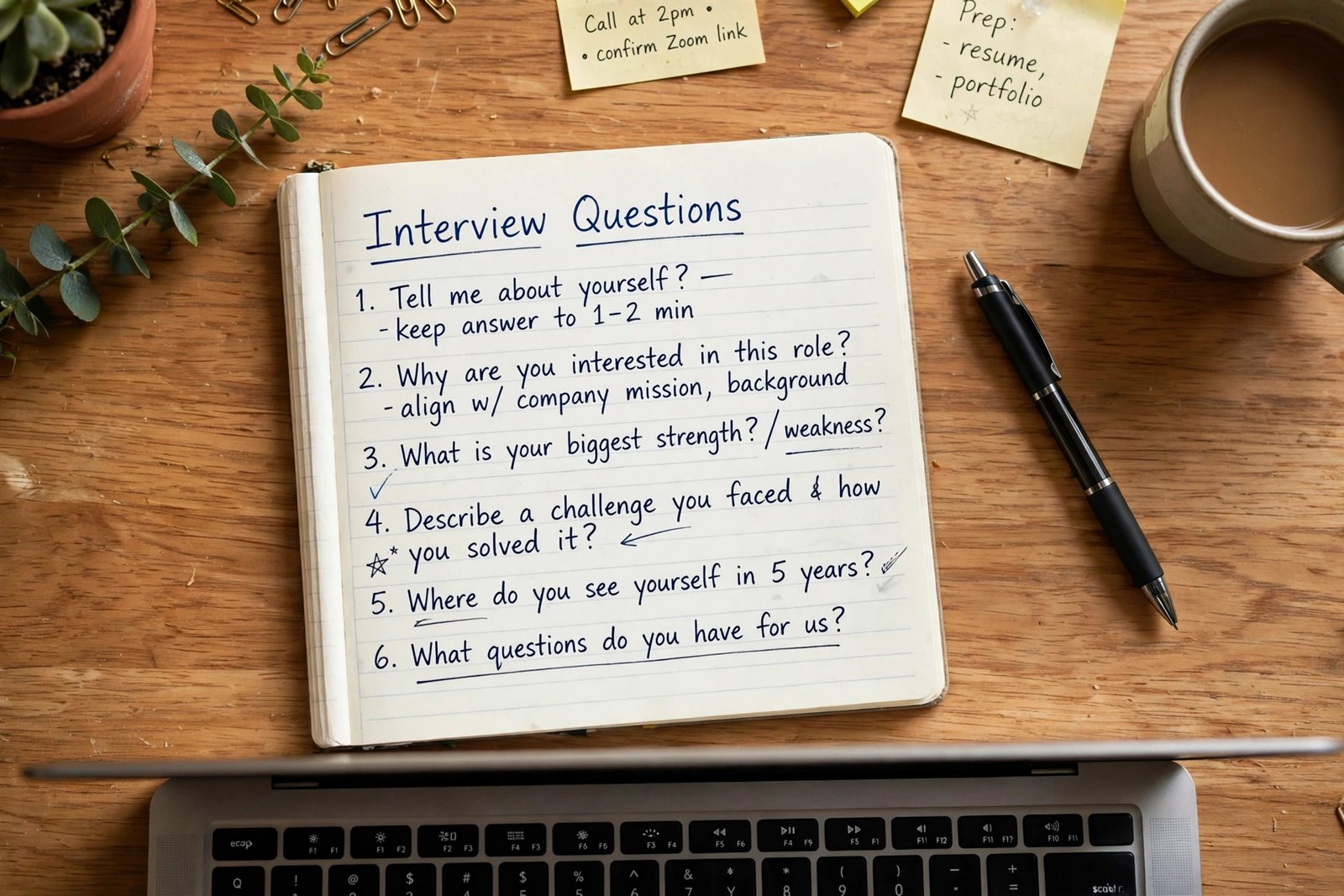
Here are the questions remote candidates hear most often, what each one is really testing, and a framework for answering well.
1. “Tell me about yourself.”
They are not asking for your life story. They want a 60-to-90-second professional summary: who you are, what you can do, and why you are here. Use the present–past–future structure: what you do now, one or two relevant experiences or skills from your background, and why this role is the right next step.
Sample answer: “I recently completed a customer service certification program, where I trained on ticketing systems and written communication for support roles. Before that, I managed scheduling and client messages for a family business, which taught me to stay organized and respond quickly. I am looking for a remote support role because I communicate best in writing and I am disciplined about managing my own schedule — and your team’s focus on fast, friendly customer replies matches exactly what I do well.”
2. “Why do you want to work remotely?”
The trap answer is “because I hate commuting” or “so I can travel.” Interviewers hear comfort-seeking in that. They want to hear that remote work fits how you already work best. Mention concrete habits: you do your best writing in quiet blocks, you have a dedicated workspace, you have worked independently before.
Sample answer: “I do my best focused work in quiet, uninterrupted blocks, and I have a dedicated home workspace where I have studied and completed projects for the past two years. I am also more responsive in writing than most people expect — I keep my inbox at zero and answer messages within the hour. Remote work matches how I naturally operate, not just where I want to sit.”
3. “How do you stay organized and manage your time without supervision?”
This is the core remote-work question — answer it with a system, not a claim. Name your actual tools and routine: a daily task list, time blocks, a calendar, a specific app. Vague answers (“I am very self-motivated”) convince no one.
Sample answer: “I plan each day the evening before in a simple to-do list, ranked by priority, and I work in focused 90-minute blocks with short breaks between them. I keep all deadlines on a calendar with reminders set a day ahead, and I send a brief end-of-day summary when a team expects one. In my certification program I juggled coursework, a part-time schedule, and applications using exactly this system and never missed a deadline.”
4. “Describe a time you solved a problem on your own.”
Remote teams need people who try before they ask. Use the STAR method — Situation, Task, Action, Result — and pick an example where you figured something out independently. Student projects, freelance work, or volunteer experience all count.
Sample answer: “During my certification course, our group project tool kept deleting our shared files the night before the deadline. Instead of waiting for the instructor, I tested three free alternatives, moved the whole project to a shared document platform in about an hour, and rebuilt the file structure so nothing was lost. We submitted on time, and the instructor adopted my workaround for the next cohort.”
5. “How do you handle communication across different time zones?”
Remote teams are often spread across the world. The interviewer wants to hear that you write clearly, over-communicate status, and respect other people’s hours. Mention async-friendly habits: detailed written updates, documented decisions, and being flexible about occasional overlap hours.
Sample answer: “I default to writing things down — clear status updates, decisions documented in shared notes, and questions asked with full context so nobody has to wait for a follow-up. I check messages at the start and end of my day to catch anything from other time zones, and I am happy to shift my hours occasionally for important overlap meetings.”
6. “What would you do if you got stuck on a task?”
They are testing whether you will sit silently for two days or ask for help intelligently. The winning answer shows a sequence: try to solve it yourself first (documentation, search, testing), set a time limit, then ask with a clear description of what you tried.
Sample answer: “I give myself a focused window — usually about an hour — to research the problem: documentation, knowledge bases, and testing possible fixes. If I am still stuck, I ask for help with a clear summary of what I tried and where exactly I am blocked, so the other person can help me fast instead of starting from zero.”
7. “Do you have experience with [specific tool]?”
Answer honestly. If yes, give a brief example. If no, say so — then immediately add that you learn tools quickly and give proof: “I had never used a ticketing system before my certification, and I was handling real practice tickets within a week.” Employers would rather hire a fast learner who is honest than someone who bluffs and breaks things on day one. (If you are still building skills, our guide to online certifications that can land you a remote job lists credentials that teach exactly these tools.)
Smart Remote Job Interview Questions to Ask the Employer
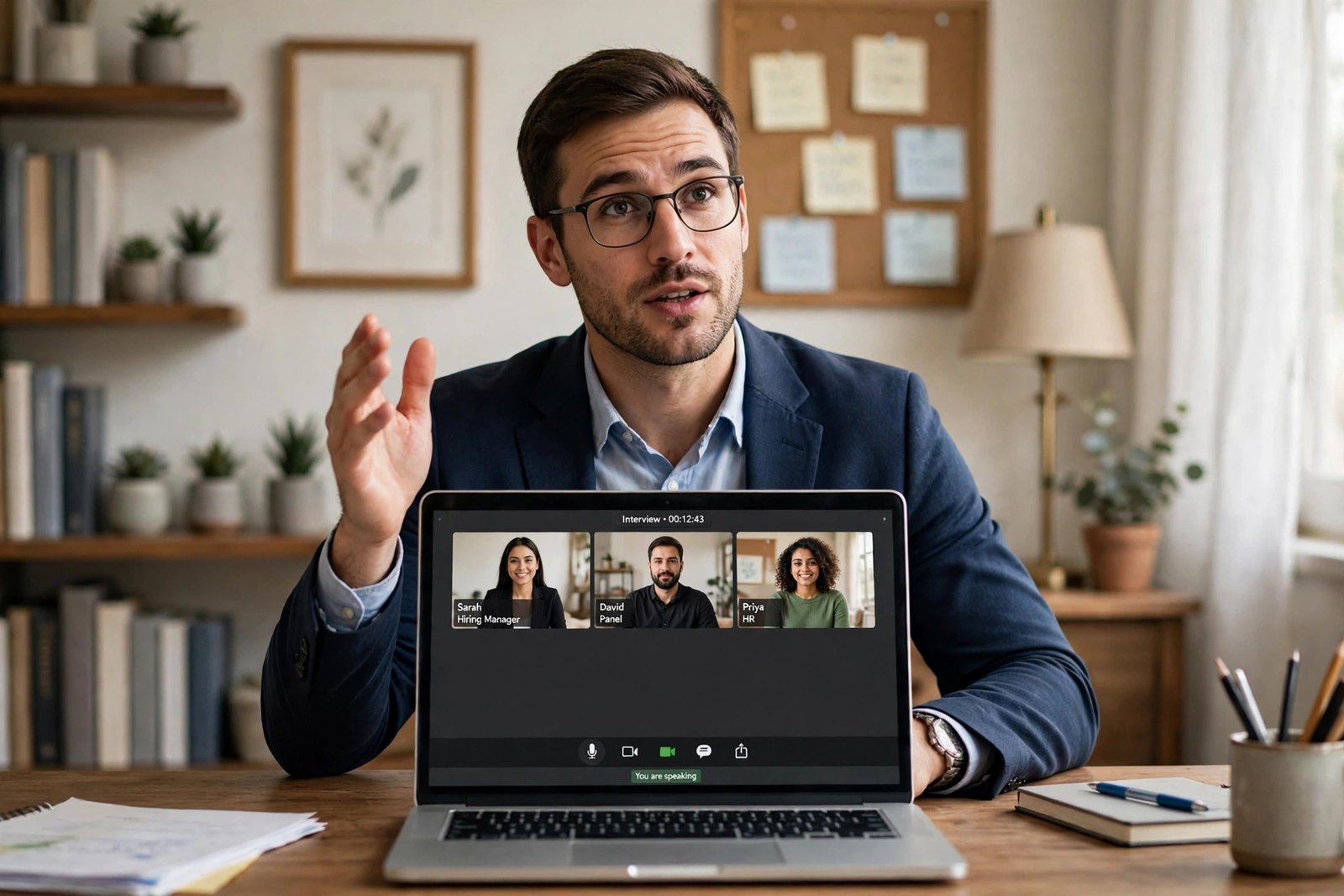
When the interviewer says “Do you have any questions for us?” — never say no. Asking sharp questions is one of the strongest signals you can send, and it also tells you whether this is a company worth joining. Pick three or four from this list:
- “What does a typical day or week look like in this role?”
- “How does the team usually communicate — chat, video, email — and how often?”
- “How is performance measured for this position?”
- “What does the onboarding and training process look like for remote hires?”
- “What are the biggest challenges someone in this role faces in the first three months?”
- “Is there room to grow into other roles on the team over time?”
Listen carefully to the answers. Vague answers about performance measurement or onboarding are a warning sign — good remote companies have thought these through.
The Day of the Interview: A Simple Checklist
- Join the link 5–10 minutes early; test audio and video
- Dress fully as you would for an office interview — at least from the waist up, but fully is safer
- Phone on silent, notifications off, door closed
- CV, notebook, questions list, and water within reach
- Smile when you greet them — it genuinely changes how you sound
- Take brief notes during the call (names, role details, next steps)
One more tip: record nothing without permission, but do write down your own answers afterward. If there is a second round, you will want to build on what you said rather than repeat it.
What to Do After a Remote Job Interview
The interview does not end when the call ends. Within 24 hours, send a short thank-you email to each interviewer: thank them for their time, mention one specific thing you discussed (this proves you were listening), and restate briefly why you are excited about the role. Three to four sentences is enough — nobody reads a second cover letter.
If they gave you a timeline (“we will decide by Friday”), wait until a day after it passes before following up. If they gave no timeline, one polite follow-up after a week is appropriate. Then move on and keep applying — the best negotiators and the least anxious candidates are the ones with other options in motion.
When an offer does come, read it carefully before celebrating: confirm the working hours and time zone expectations, the equipment policy (do they provide a laptop or do you use your own?), and how paid time off works for remote staff. Asking these questions is professional, not pushy.
Video Call Body Language: How You Come Across on Camera
On a video call, the interviewer sees a small rectangle — and judges everything inside it. The good news is that a few simple habits make you look confident even when you feel nervous.
Look at the camera, not the screen. When you answer an important point, glance at the camera lens for a few seconds. It reads as eye contact. Staring at the interviewer’s face on screen the whole time makes you look like you are looking slightly away.
Sit up and stay still. Good posture signals energy. Avoid swaying in your chair, touching your face, or fidgeting with a pen — the camera magnifies every small movement. Keep your hands visible on the desk when you are not gesturing; hidden hands subconsciously read as hiding something.
Slow down and pause. Nerves make people rush. Speak slightly slower than feels natural, and take a one-second pause before answering a tough question — it looks thoughtful, not hesitant. If you need a moment, say “That is a good question, let me think for a second” — interviewers respect it.
Smile at the start and the end. You do not need to grin through the whole call, but a genuine smile when you greet them and when you say goodbye frames the entire conversation warmly. People remember how an interview felt more than what was said.
How to Handle Async and Recorded Interviews
Some companies skip the live call and send an async interview instead: a set of written questions to answer, or prompts you record yourself answering on video. Do not treat these casually — they are judged just as seriously.
For written async interviews, your writing IS the interview. Use full sentences, organize longer answers with short paragraphs, and proofread twice. This format actually favors careful communicators: you can take time to give your best answer, so give it.
For recorded video answers, you usually get a time limit per question (often two to three minutes) and sometimes only one or two attempts. Practice your key answers out loud first, then record in the same clean setup you would use for a live call. Watch your recording once before submitting — check the audio is clear and you actually answered the question asked. One practical trick: write three bullet points per answer on a sticky note next to your camera, so you stay on track without reading from a script.
Red Flags to Watch For in Remote Interviews
Not every remote opportunity is legitimate. Stay alert for these warning signs during the process:
- They ask you to pay for equipment, training, or “registration” before starting — real employers never do this.
- The interview happens only over chat with no video call, and they offer you the job within minutes.
- They ask for bank details or ID documents before you have signed anything.
- The job description promises unusually high pay for very simple work with no interview at all.
A real hiring process takes time and includes real conversations. If it feels rushed or too easy, trust that instinct.
Final Thoughts
Preparing for remote job interview questions is really preparing for two things at once: proving you can do the job, and proving you can do it from home. Set up your space and tech the day before, answer with specific examples instead of vague claims, ask sharp questions back, and follow up within 24 hours. Most candidates wing it — the ones who prepare stand out immediately, even with no prior remote experience.
Your next step is simple: pick the five questions from this guide that feel hardest, write your answers down, and say them out loud once. That single hour of practice will do more for your confidence than a week of worrying. Good luck — the remote role you want is one good interview away.