How to Get a Remote Job With No Experience: The Complete 2027 Guide
Working from home used to be a rare perk. In 2027, it is simply how millions of people work every day. Customer support teams, marketing departments, and entire startups now operate with employees spread across cities and countries — and many of those employees started with zero professional experience.
If you are wondering how to get a remote job with no experience, you are asking the right question at the right time. Employers hiring remotely care less about your job history and more about whether you can communicate clearly, manage your own time, and learn fast. This guide shows you exactly how to position yourself for those roles: which entry-level remote jobs actually exist, what skills to build first, where to find legitimate openings, and how to write applications that get replies — even when your CV has a blank work history section.
Is It Really Possible to Get a Remote Job With No Experience?
Yes — but it helps to understand why it is possible, so you can play to your strengths.
Remote hiring works differently from traditional hiring. When a company hires someone for an office role, they often weigh years of experience heavily. When they hire remotely, they worry about different things: Will this person answer messages on time? Can they work without a manager looking over their shoulder? Do they write clearly enough to replace hallway conversations with chat messages?
A fresh graduate, a career switcher, or a stay-at-home parent returning to work can answer “yes” to all of those questions. Experience helps, but for entry-level remote roles, reliability and communication matter more. Companies know that someone motivated can learn a ticketing system or a content calendar in a few weeks — but they cannot teach someone to be dependable.
That said, “no experience” does not mean “no preparation.” The candidates who succeed are the ones who build a small set of relevant skills, create simple proof of what they can do, and apply strategically. That is exactly what this guide walks you through.
What Employers Look For in a Remote Job With No Experience
Before listing job titles, let us look at this from the employer’s side. When a hiring manager opens an application from someone with no work history, they scan for five things:
1. Clear written communication. Remote work runs on writing — emails, chat messages, tickets, documentation. If your application itself is well-written, that is your first proof.
2. Self-discipline and time management. Nobody will remind you to start work. Mentioning how you organize your day (even from student life or freelance projects) reassures them.
3. Basic digital fluency. You do not need to be a programmer, but you should be comfortable with email, video calls, shared documents, and learning new tools quickly.
4. Willingness to learn. Entry-level roles come with training. Employers want people who ask good questions and follow processes carefully.
5. A relevant skill, even a small one. One concrete ability — writing product descriptions, managing a spreadsheet, editing short videos — beats a page of generic claims.
Notice what is not on this list: a degree from a famous university, five years of experience, or an impressive job title. For the roles below, those five qualities are the real requirements.
Best Entry-Level Remote Jobs for Beginners in 2027
These are real categories of remote roles that regularly hire people without prior professional experience. Each one has a short description so you can pick the ones that fit your strengths.
1. Customer Support Representative
The most common entry point into remote work. You answer customer questions by chat or email, follow documented procedures, and escalate complex cases to senior staff. Companies provide training on their product, so what matters is patience, clear writing, and a calm tone.
2. Virtual Assistant
Virtual assistants handle scheduling, inbox management, data entry, and research for busy professionals or small businesses. If you are organized and detail-oriented, this role lets you build experience across many small tasks — and many assistants later specialize in areas like bookkeeping or social media.
3. Data Entry and Data Processing
Straightforward work: entering, cleaning, or organizing information in spreadsheets and databases. Accuracy and speed matter more than background. Be cautious here (more on scams later) — legitimate data entry jobs never ask you to pay to start.
4. Content Moderator
Social platforms and online communities hire moderators to review user-generated content against published guidelines. The work requires good judgment and emotional steadiness. Training is provided; consistency and attention to detail are what get you hired.
5. Junior Copywriter and Content Writer
If you write well, businesses need blog posts, product descriptions, social media captions, and email newsletters. A small portfolio of sample articles — even self-published ones — can substitute for professional experience. (Our guide on online certifications that can land you a remote job includes writing-adjacent credentials worth considering.)
6. Social Media Assistant
Small brands need help scheduling posts, replying to comments, and tracking basic metrics. If you already use social platforms daily and understand what makes content perform, you are closer to qualified than you think.
7. Transcriptionist
Converting audio recordings into written text. Good listening skills, fast typing, and careful punctuation are the requirements. Some companies ask for a short skills test instead of a CV — which is actually good news if your CV is thin.
8. Sales Development Representative (SDR)
Entry-level sales roles where you research prospects and start conversations by email or phone. Companies train you on their pitch; they hire for confidence, persistence, and communication. Performance is measured clearly, which means fast learners can advance quickly.
Pick two or three of these that match your natural strengths, and focus your preparation there instead of applying to everything at once.
Skills That Help You Land a Remote Job With No Experience
You do not need to master everything. But spending two to four weeks deliberately building the skills below will put you ahead of most other beginners applying for the same roles.
Written Communication
This is the single most important remote-work skill. Practice writing short, clear messages: no rambling, no missing context, no typos. A good exercise is to rewrite a confusing email you received into a clearer version. Employers notice this skill in your cover letter before they notice anything else.
Everyday Digital Tools
Get comfortable with the tools remote teams use daily: video calling (Zoom, Google Meet), team chat (Slack, Microsoft Teams), shared documents (Google Docs, Sheets), and task boards (Trello, Asana). Free versions of all of these exist — create accounts, click around, and learn the basics. Listing them on your CV signals that you can start contributing from day one.
Time Management and Self-Discipline
Remote workers manage their own schedules. Start practicing now: set a daily routine, use a simple to-do list, and track how you spend your working hours for a week. When an interviewer asks how you stay productive at home, you will have a real answer instead of a vague promise.
One Marketable Hard Skill
Pick one concrete skill tied to the roles you want: spreadsheet formulas for data roles, basic Canva design for social media roles, or short-form writing for content roles. Free tutorials on YouTube and free courses on platforms like Coursera or HubSpot Academy are enough to reach a usable level. Certifications are not required, but they add credibility — our certifications guide linked above lists affordable options that pair well with remote job applications.
Basic English Proficiency
Most remote jobs — even at companies in non-English-speaking countries — involve some English communication. You do not need perfect grammar, but you should be able to write a professional email and hold a video conversation. If English is a weak point, improving it is one of the highest-return investments you can make for remote work.
Where to Find a Legitimate Remote Job With No Experience
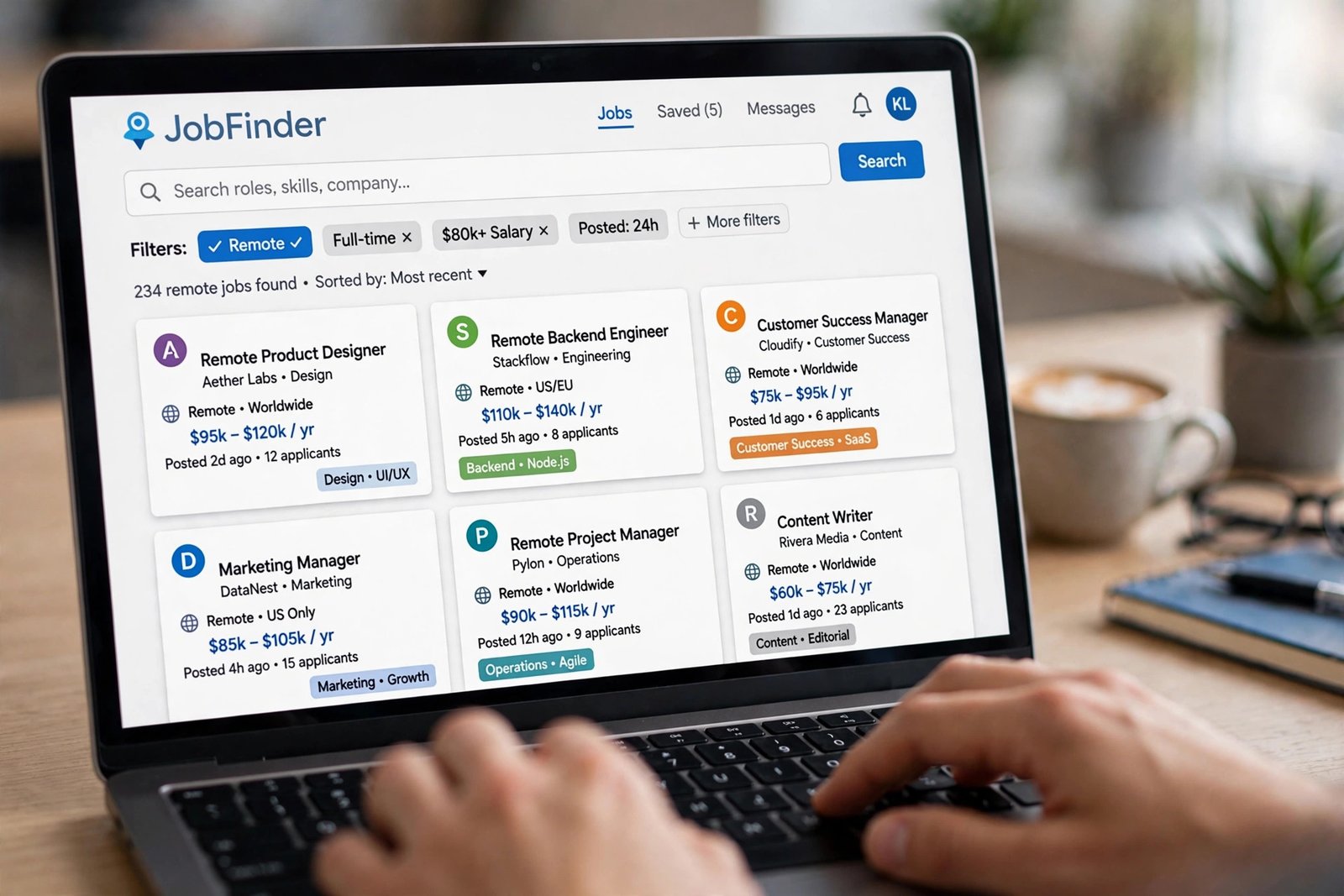
Knowing where to look saves you from wasting time on the wrong platforms — and from scams.
• LinkedIn — Use the “Remote” location filter. Many large companies post entry-level remote roles here, and you can see who else applied.
• Indeed — Another major board with a remote filter. Set up email alerts for your target job titles so new postings reach you first.
• We Work Remotely, RemoteOK, and FlexJobs — Boards dedicated to remote work. FlexJobs charges a small subscription but screens every listing for legitimacy, which some beginners find worth it.
• Company career pages — If you admire a specific company, check its own careers page. Many remote-first companies post there before anywhere else.
• Freelance platforms (Upwork, Fiverr) — Not traditional jobs, but a practical way to earn your first paid experience and client reviews, which then strengthen future job applications.
A word of caution that deserves its own section: never pay a fee to get hired, never share bank details during the application stage, and be suspicious of interviews conducted only over text chat with no video call. Legitimate employers pay you — the money flows in one direction.
How to Build Proof of Skill Without a Job History
“No experience” is only a problem if you have nothing to show. You can create credible proof in a few weeks:
• Write sample work. Aspiring writers can publish three sample blog posts on a free blog. Aspiring designers can redesign a local business’s flyer as a portfolio piece. Aspiring assistants can document a system they built to organize their own tasks.
• Do small freelance or volunteer projects. Offer to manage social media for a family business, transcribe a podcast episode, or help a nonprofit with data entry. Real deliverables with real names attached beat hypothetical examples.
• Complete a short course and show the project. Many free courses end with a capstone project. Put that project in your portfolio with a one-paragraph explanation of what you did.
• Create a simple personal website or LinkedIn profile. A clean LinkedIn profile with a professional photo, a clear headline (“Aspiring Virtual Assistant | Organized, Detail-Oriented, Available Immediately”), and your sample work linked is often enough for entry-level applications.
Hiring managers for beginner roles do not expect a long employment history. They expect evidence — one or two concrete things that prove you can do the work.
How to Write Applications That Get Replies
Your application has two jobs: pass the initial scan and make a human curious enough to interview you.
Tailor every application. Read the job description carefully and mirror its language. If it asks for “strong written communication and experience with Google Sheets,” your CV should literally contain the phrases “written communication” and “Google Sheets” — with a one-line example for each. Generic applications get generic rejections.
Write a short, specific cover letter. Three short paragraphs are enough: why this role, what you bring (skills + proof), and why you want to work remotely for this company specifically. Mentioning something real about the company — a product you tried, a blog post you read — instantly separates you from copy-paste applicants.
Keep your CV to one page. With no work history, one page is natural. Lead with a skills summary, then education, then projects or freelance work, then any certifications. Our step-by-step guide on how to write a CV that gets you hired covers formatting in detail — and yes, the formatting rules matter just as much for remote applications.
Follow instructions exactly. If the posting says “include the word ‘pineapple’ in your subject line,” do it. Many remote employers use small instruction tests to filter out applicants who skim. Attention to detail is the whole job in remote work.
Apply consistently. Treat applications like a routine: a set number per day, tracked in a simple spreadsheet with the company, role, date, and status. Most beginners who “can’t find anything” simply stopped applying after twenty rejections. The process is a numbers game with a skill component — both matter.

How to Prepare for Remote Job Interviews
Remote interviews usually happen over video, and they test slightly different things than in-person ones.
Test your setup in advance. Stable internet, a working camera and microphone, and a tidy, quiet background. Join the call five minutes early. Technical fumbling in the first minute creates a bad impression that has nothing to do with your abilities.
Prepare for the classic remote questions. Expect: “How do you stay productive working from home?”, “Tell me about a time you had to learn something on your own,” and “How do you handle it when you’re stuck and no one is available to help?” Have short, honest stories ready — from studies, freelance work, or personal projects.
Show, don’t just tell. If you built a sample project, share your screen and walk through it. A two-minute demo of real work is more convincing than ten minutes of claims.
Ask good questions. “What does a typical week look like in this role?” and “How does the team communicate day to day?” show that you are thinking seriously about the actual work — and the answers tell you whether the job is genuinely remote-friendly.
Send a thank-you message. A brief email after the interview, referencing something specific you discussed, keeps you memorable. Few candidates do this; it costs you two minutes.
Remote Job Scams: Red Flags Every Beginner Must Know
Beginners are the favorite targets of job scammers, precisely because they are eager and less familiar with normal hiring. Memorize these red flags:
• They ask you to pay. For “training,” “equipment,” “background checks,” or “software licenses.” Real employers never charge applicants.
• The offer comes too easily. Hired after one short text chat, no real interview, no questions about your skills? That is not efficiency — that is a trap.
• They send you money first. The classic scam: they “accidentally” overpay you and ask you to return the difference. The original payment bounces; your refund does not.
• Communication is unprofessional. Free email addresses (not company domains), poor grammar in official documents, pressure to decide immediately, or refusal to do a video call.
• The job description is vague but the pay sounds amazing. High pay for simple work with no clear duties is bait. Compare any offer against similar roles on established job boards.
When in doubt, search the company name plus the word “scam,” check whether the company has a real website and verifiable employees on LinkedIn, and trust your instincts. A missed opportunity costs you nothing; a scam can cost you money and your identity documents.
Frequently Asked Questions
Can I really get a remote job with no experience and no degree?
Yes. Many entry-level remote roles — customer support, data entry, virtual assistance, content moderation — hire based on skills and reliability rather than degrees. A degree helps in some fields, but for the roles listed in this guide, demonstrated skill and clear communication matter more.
How long does it take to land the first remote job?
It varies widely. Candidates who spend 2–4 weeks building one marketable skill, create simple proof of that skill, and apply consistently often see results within one to three months. Those who apply sporadically with a generic CV can search much longer. Consistency and tailoring are the two biggest accelerators.
Do I need my own computer and internet?
Almost always, yes. Most remote employers expect you to have a reliable computer, a stable internet connection, and a quiet place to work. Some customer support roles provide equipment after hiring, but you should assume you need your own setup to start.
Should I accept unpaid trial work to get experience?
Short skills tests (an hour or two) are normal. Multi-day unpaid “trials” that produce real commercial work are not — legitimate companies either pay for trial projects or keep tests brief. If a “test” looks like free labor, walk away.
Is freelancing better than a remote job for beginners?
They solve different problems. Freelancing can get you paid work faster and builds a portfolio, but income is unpredictable. A remote job gives stability and structured learning. Many beginners do both: freelance for proof and income while applying for full-time remote roles.
What is the biggest mistake beginners make?
Applying to everything with the same generic CV and no proof of skill. Pick two or three role types, build one relevant skill, create one piece of evidence, tailor each application — and your reply rate will look completely different from the spray-and-pray crowd.
Final Thoughts
Learning how to get a remote job with no experience is not about finding a secret shortcut — it is about understanding what remote employers actually buy: reliable communication, self-discipline, and one concrete skill they can put to work immediately. Build those three things, prove them with simple evidence, apply with focus instead of panic, and stay alert for scams along the way.
The first remote job is the hardest to get. The second one is dramatically easier, because “remote work experience” is suddenly on your CV. Start building your proof this week — one skill, one sample project, ten tailored applications — and you will be closer than most people who only dream about working from home.